Top Signs You Need Garage Door Service – Don’t Ignore These
A door that takes two seconds longer to open than it did six months ago isn’t aging gracefully. It’s telling you a specific component is at the end of its service life, and that component has a predictable next failure mode. The homeowners who get stranded with a car on the wrong side of a dead door are almost never blindsided. They had weeks of warnings that got rationalized as normal wear. Here’s how to read those warnings before they turn into a breakdown.
If a symptom below matches what you’re hearing or seeing, call (833) 508-9161. We’ll tell you what’s likely going on before anyone comes out.
Why Garage Doors Rarely Fail Without Warning
Garage doors fail in sequence, not at random. Every part in the system has a wear cycle, and each part announces the end of that cycle in a specific way. Springs lose tension gradually, rollers flat-spot and start to drag, cables fray before they snap, and openers labor harder as friction climbs. What most people experience as a sudden failure is really the last step in a chain that started months earlier.
That chain is the whole reason this post exists. We’d rather you call us about a slow door in Doral than about a spring that let go while the car was halfway in. Spring repair done safely means catching the warning while the door still moves. Once a torsion spring breaks, the door can drop fast and hard, and that’s when a simple repair becomes an urgent one.
Here’s the short version to keep in mind. Slower movement points to tension loss. New noises point to a specific worn part. Reversals point to a sensor or force problem. Different symptoms, different causes, different fixes.
Sign #1: The Door Moves Unevenly or Looks Crooked
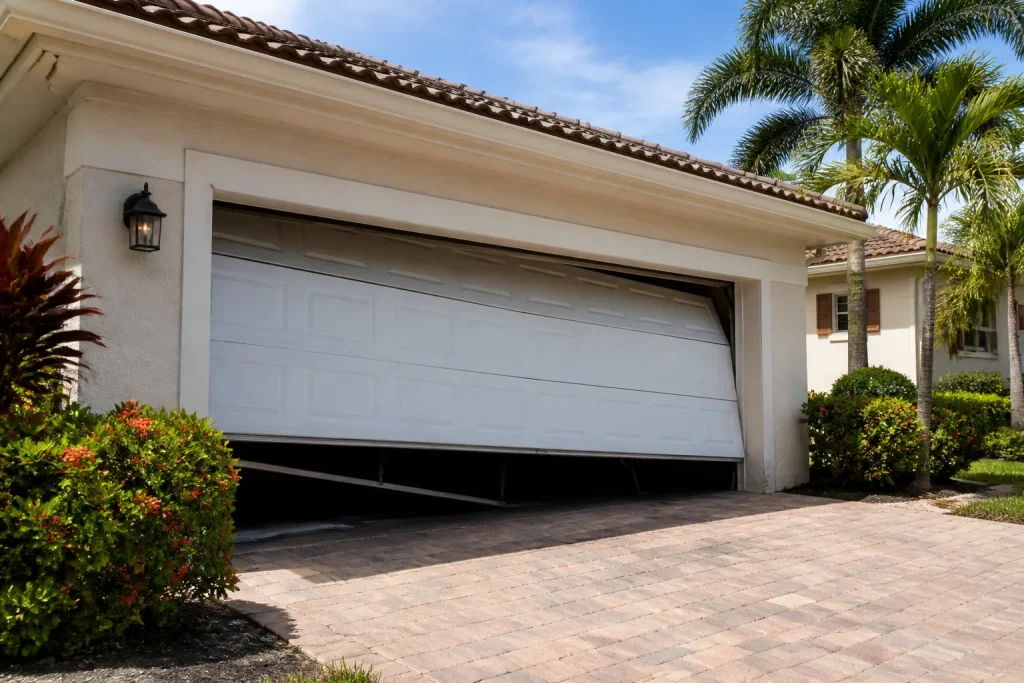
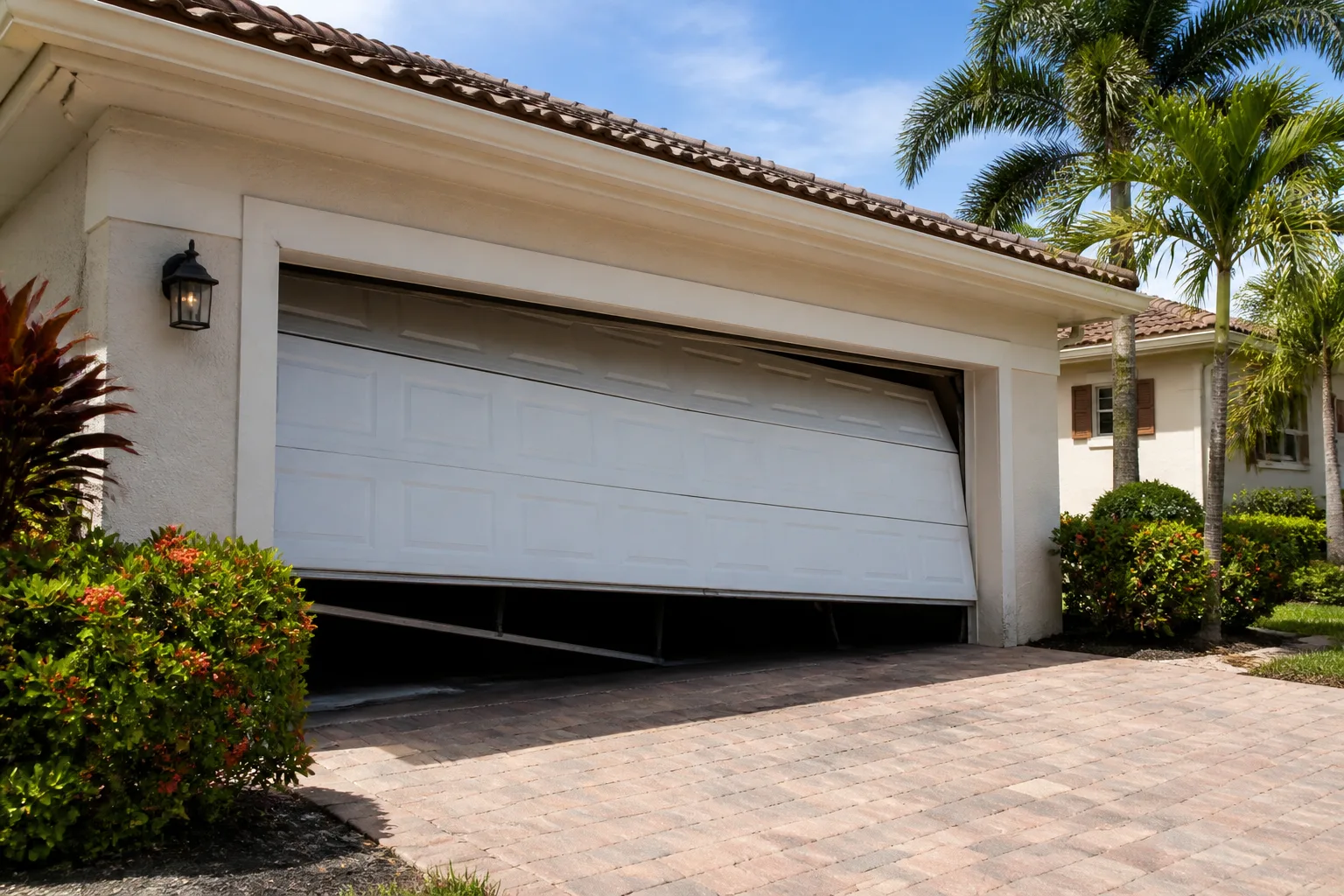
Uneven movement is the most misdiagnosed symptom on this list. A door that rises lopsided, jerks on one side, or leaves a visible gap at one corner can come from two very different problems, and they don’t share a fix. The first step is figuring out which one you’re looking at.
- Spring tension imbalance: One torsion spring carries more load than the other, or a single-spring system has started to lose tension. The door lifts harder on one side and may sit crooked when closed. This is a spring issue, and springs are the genuinely dangerous part of the system.
- Roller wear: Flat-spotted, dried-out, or seized rollers drag on one side of the track and make the door climb unevenly. The springs may be perfect and the door still looks off.
- Track misalignment: A bent or out-of-line track forces the door to fight its own path, which shows up as a scraping or binding movement.
Spring tension and roller wear can look nearly identical from the ground, which is why we don’t recommend guessing. Both are worth a proper look, and one of them is not a job for a ladder and a pair of gloves. If your door in Doral has started moving crooked, that’s the moment to call rather than wait for the next stage. A spring that’s already out of balance tends to get worse, not better.
Sign #2: The Door Reverses for No Reason
An opener that reverses mid-travel, or reopens right after it closes, is not having a sensitivity glitch. It’s doing exactly what it’s built to do, which is refuse to close on something it thinks is in the way. When it happens with a clear floor, it means the safety system is misreading the world, and that’s a calibration problem: either the sensors or the opener’s force setting.
The safety sensors sit at the base of the track on each side and beam an invisible line across the opening. Dirt, a bumped bracket, or a spider web across the lens is enough to trigger a reversal. That one you can usually solve by cleaning the lenses and checking that the brackets face each other. If the opener still reverses after that, the force calibration is likely set too low, or the opener is sensing real resistance from a dragging door.
Here’s the part worth sitting with. A door that reverses for no reason is a door that may also fail to reverse when something is actually underneath it. The same sensor system that triggers false alarms is your protection against a real one. If you drive a Genie or Chamberlain opener and the reversals come and go, don’t treat it as a quirk. That’s a safety call, and garage door opener repair covers both the sensor side and the force setting. In Doral, humidity and dust work on those sensor lenses faster than most people expect, so cleaning is often the whole fix and it’s worth a try first.
Sign #3: New Noises, and What Each One Tells You
Garage doors talk. The sound a door makes is one of the most useful diagnostic clues you have, and the sounds are distinct enough to separate into categories. Listen for which of these matches what you’re hearing.
- A sharp snap or pop, followed by the door hanging dead: That’s a broken torsion spring. Stop using the door and call for emergency service. Do not try to lift it manually.
- A scraping or metallic grinding along one side: Most often a roller that’s seized or worn flat and is dragging along the track. It gets worse with use.
- A creaking, groaning sound as the door travels: Usually dry or worn rollers and hinges, sometimes a cable running dry. This is the early-warning sound and the easiest to catch in time.
- A twanging or snapping sound with the door still working: A fraying cable. Cables fail under extreme tension and this is a professional repair, not a weekend project.
- A rattling or banging from the track: Loose track hardware or a track pulling away from its mounting. Left alone, the door can come off track.
If you only remember one thing, remember that a new sound never means normal. A door in Doral that starts grinding in the dry season usually keeps grinding into the wet one. Track that noise back to a part and you’ve found the failure before it happened.
Sign #4: The Door Feels Heavier, or You’ve Started Adjusting Around It
This is the quietest sign on the list and the most common. The door closes slower than it used to. You nudge the opener travel setting up a notch. You press the remote and wait a beat longer. Each small adjustment hides a little more of what’s actually going on underneath.
Here’s the slow-close symptom in plain terms. When a torsion spring loses tension, it stops lifting its share of the door’s weight. The opener picks up the slack, so the door still opens, just slower and with more strain on the motor. Adjusting the opener’s travel or force setting masks the symptom without touching the cause. Meanwhile the opener is working harder than it was designed to, and the spring is getting closer to failing completely.
The tell is simple. Lift the door about halfway by hand (carefully, and only if it isn’t already stiff or stuck), then let go. A healthy door holds roughly in place, because the springs balance the weight. A door that drops or feels far heavier than it should has a spring problem. That’s a signal to stop lifting it and call. A door in Doral that’s gotten slow on the remote is usually not a remote issue at all, and re-flashing the opener won’t fix a spring.
Sign #5: Rust and Corrosion Where You Don’t Expect It
South Florida humidity doesn’t just make the air feel thick. It works on garage door hardware from the inside out, and the places it attacks first are the ones people never look at. That’s why corrosion is one of the most reliable warning signs in this climate, if you know where to check.
- The torsion shaft: Early-stage rust here isn’t cosmetic. That shaft carries the full winding force of the springs, and surface corrosion means water is getting into the spring coils too, which is exactly where a spring’s integrity lives.
- Hinges and rollers: Rust on the hinge points and roller stems adds friction to every open and close. The door starts dragging, the opener works harder, and the whole cycle shortens.
- Tracks and bottom brackets: Pitting on the track and rust at the bottom bracket edges point to moisture sitting where it shouldn’t.
A little surface rust on a lift bracket is nothing. Rust creeping along a torsion shaft or into the spring coils is an early-stage warning that a spring is on borrowed time. If you own a Clopay or Amarr door, the panels will hold up well; it’s the moving hardware underneath that needs the eye. Doral homeowners who check their torsion shaft once a season catch a lot of spring trouble before it starts.
When to Call a Pro (and When You Can Handle It)
Some of these signs are things a careful homeowner can manage. Some are absolutely not. Knowing the line between the two is the whole point of this post.
Handle it yourself: cleaning safety sensor lenses, wiping down and lightly lubricating hinges and rollers, tightening a visibly loose track bracket, and checking that the sensor brackets face each other.
Call a pro: any uneven or crooked movement, any broken spring, any fraying cable, a door that’s off its track, an opener that reverses without cause, and any door that suddenly feels too heavy to lift. Springs and cables are under extreme tension and can injure seriously if handled wrong. A trained technician has the tools and the procedure for that, and there’s no version of it that’s safe to improvise.
One specialist, start to finish, matters here. A garage door isn’t a plumbing call or an electrical call, and the technician who works on nothing else knows the failure patterns cold. If you’re in Doral and want an expert eye on a symptom, we offer garage door spring repair and full garage door repair to get you from warning sign to working door.
Related services in Doral: spring repair, opener repair, and new door installation are all available through one specialist. If a repair turns into a replacement, you don’t need to source a second company.
The Bottom Line
Most garage door failures announce themselves weeks before they happen. Uneven movement points to spring tension or roller wear. Unexplained reversals mean a sensor or force problem. New noises each have a distinct cause, and a door that’s gotten slow is usually a spring losing tension behind an opener that’s being adjusted to compensate. Add in South Florida humidity working on torsion hardware, and you have a short list of symptoms worth catching early. Our technicians have up to 15 years of experience diagnosing exactly these patterns, and we service every major brand, including Genie, Clopay, and Wayne Dalton.
If you’re in Doral and need help, Doral Garage Door Repair Pros offers free estimates. Call (833) 508-9161 and we’ll get the right technician to you. Emergency service is available when a door fails and your home’s security is on the line. When you lead with the right specialist from the start, you get it fixed once and done.
Looking for the team that covers everything from a snapped spring to a full install? Start with Doral Garage Door Repair Pros.
Frequently Asked Questions
One part failing is a repair; a door with widespread panel damage, a bent track, or hardware at the end of its life across the board is usually a replacement call. Most doors we look at only need a repair, and a technician can tell you within a few minutes which side you’re on. If you’re in Doral, call (833) 508-9161 for a free estimate before you assume the worst.
It usually means a torsion spring has lost tension and the opener is carrying weight it wasn’t designed to carry. It can also point to dragging rollers or dry hinges adding friction. Adjusting the opener doesn’t fix either cause. Have the springs and rollers checked before the door stops entirely.
The safety sensors or the opener’s force calibration are misreading the doorway. Clean the sensor lenses and check the brackets first; if the door still reverses, the force setting or a binding door is the cause. A door that reverses falsely may also fail to reverse when it should, so treat it as a safety issue and call for service.
No. Torsion springs are under extreme tension and can cause serious injury if handled incorrectly. Replacement requires proper tools and technique. That’s a job for a trained technician, not a homeowner with a ladder. Call (833) 508-9161 and let a specialist handle it safely.
Written by the team at Doral Garage Door Repair Pros.
Need Garage Door Help?
Call Doral Garage Door Repair Pros - the local pro we connect you with is licensed and insured, here with fast after-hours help in Doral.
(833) 508-9161